

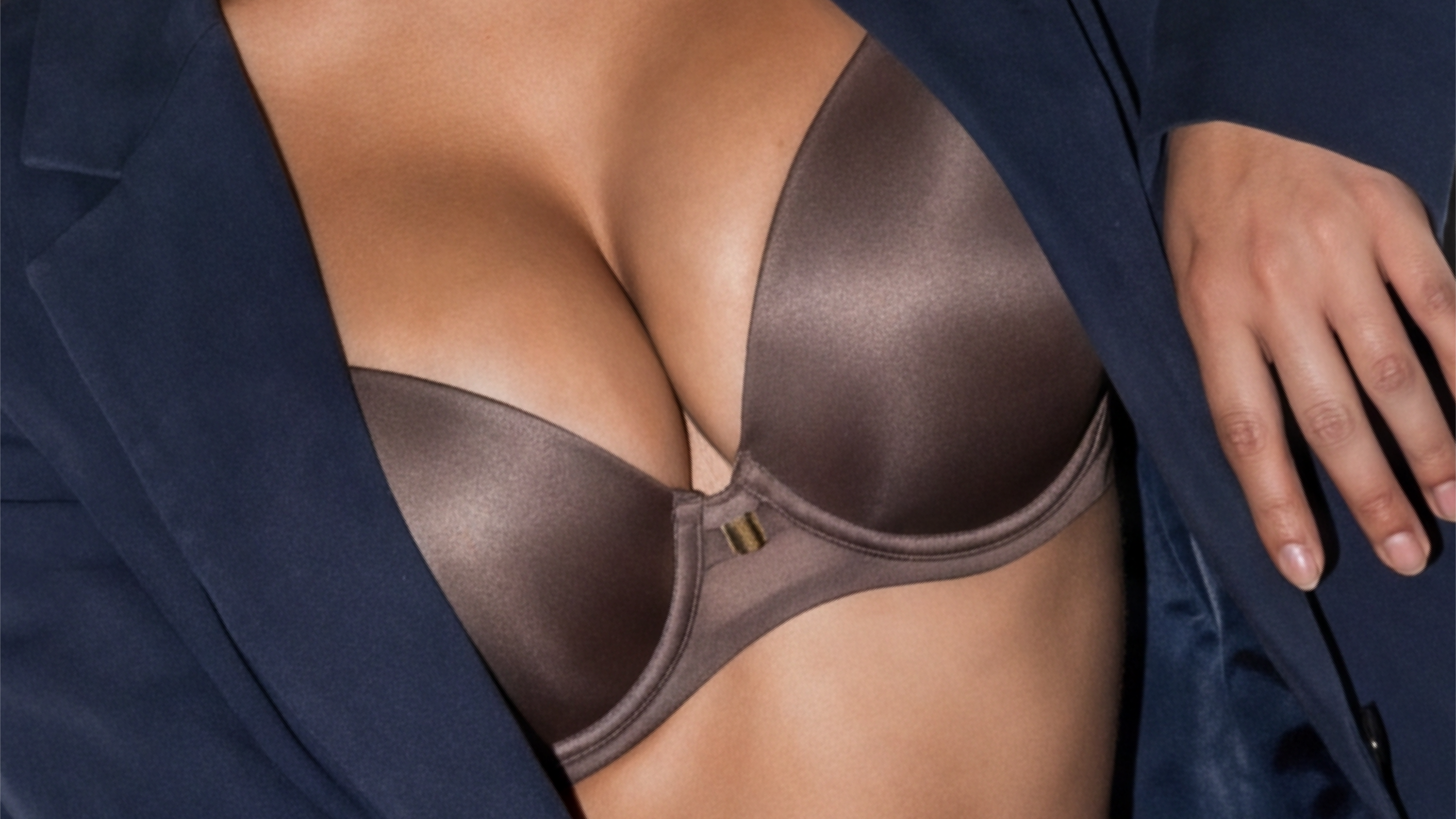
The Science Behind Figiúra
ENGINEERED FOR IMPLANT ANATOMY
Validated by data. Confirmed by research.
253 women
We studied hundreds of women in real fitting environments over three and a half years. Our sample included submuscular and subglandular placements, across low, moderate, high, and extra-high implant profiles.
96.8%
Almost all women reported fit issues with standard bras — across every placement type, profile, and size. The consistency of that number is the finding. This is not a niche problem. It reveals a fundamental design flaw.
85%
Most women we researched had undergone at least one revision — a second surgery. Bra choice affects how your implant sits over time — and whether it stays where it was placed. The right bra protects your investment.

AUGMENTED ANATOMY
Breast implants are not a variation of natural tissue. They are structurally distinct.
Natural breast tissue is malleable. It compresses, spreads, and molds to fit the available space. A standard bra cup is designed for that behavior.
Implants don’t compress. They project forward, sit higher on the chest, and concentrate volume toward the center. A standard cup cannot accommodate that geometry — which is why the gore floats, the cups overflow, and the underwires end up in the wrong place.
The research
253 women. Three and a half years. Consistent structural failures.
Standard cups cannot accommodate dominant forward projection. Volume has nowhere to go.
Implants sit closer together with more volume at the center. The gore has nowhere to land — it lifts off the chest, floats over tissue, and no amount of band tightening fixes the problem.
Wire channels built too wide and too high. The result: sternum pressure and underarm digging.
Standard Bras vs. Figiúra
Published medical research confirms what 253 women already knew. Implant-based anatomy is measurably different — semi-spherical rather than teardrop, sitting higher on the chest, with volume concentrated forward and inward. The industry designed the standard based on natural anatomy — women with implants were not considered. The finding is unambiguous: Standard bras fail implant-based breasts, and the construction has to change.

standard bras

Figiúra
THE SOLUTION
Four features. One purpose.
Each Figiúra design element addresses a documented structural failure of standard bra design on implant anatomy. Nothing is decorative. Everything starts from the geometry of your body — not an adjusted pattern.

Revolution Form J-Frame®
Support is distributed through the architecture — not the straps. The bust sits front and centered, lifted without compression. The J-Frame’s centering also supports implant pocket integrity, reducing the mechanical stress that contributes to lateral migration and bottoming out.

Deeper Cups
Engineered for the dominant forward projection specific to implant anatomy. Unlike natural tissue, implants don't compress to fit the cup — they project outward, and the cup has to meet them there. Deep cups also allow the center to sit flush. No floating gore, no overflow, no edge compression. Volume contained precisely, not compromised.

Performance-Flex Underwire
Engineered to align with implant base geometry while enabling controlled flexibility. Traditional underwires sit too wide, too high, too rigid. Figiúra's wire follows the actual root geometry of implant-based breasts, paired with a performance-flex contour that moves with the body. No sternum pressure. No underarm digging.

Beyond Suave® Liquid Silk Knit
A high-performance knit that meets the demands of implant-based support engineering. Exceptional stretch recovery maintains shape throughout wear. Cooling hand-feel. Liquid-silk finish. The part of the engineering you actually feel. Supportive enough to work. Refined enough to wear for its own sake.
Selected Citations
Nicklaus, K. M., Liu, Y. T., Chi, L., Chu, J., Jewett, E., Bravo, K., Bordes, M. C., Liu, J., Reece, G. P., Hanson, S. E., Merchant, F., & Markey, M. K. (2023). Impact of implant-based breast reconstruction on bra fit. Ergonomics, 66(10), 1521-1533.
Zhang, Y., Zhang, H., Hu, J., Jiang, Y., Zheng, F., Zeng, A., Long, X., & Wang, X. (2026). Evaluation of Natural Breasts and Post-Augmentation Breasts with Silicone Implants Using Subject-Specific Finite Element Modeling. Annals of Biomedical Engineering, 54(6), 1638–1651.