

Fit Guide
FIG METRICS: FIND YOUR FIT
Standard sizing assumes that your breasts compress and move a certain way. But implant anatomy plays by different rules — it projects forward, sits higher and more centered on the chest, and doesn’t compress like natural tissue.
Figiúra uses “Fig Metrics” — a two-step approach that accounts for how your body actually works.
STEP 1
MEASURE YOUR BAND
A well-fitted band is what delivers the lift and support. Figiúra’s Revolution Form J-Frame® does the rest.
Wrap a soft measuring tape snugly around your ribcage, just below your bust — where your bra band sits. Keep it level all around. The band should feel secure, but not too tight.
Record your measurement in inches.

STEP 2
LEAN FORWARD & MEASURE ONE BREAST
With implants, measuring your cup size requires a different approach.
Lean forward at a 45-degree angle. Place the measuring tape at center front, between your breasts (the middle of your breastbone). Run it across the fullest part of one individual breast to where your breast tissue ends at the side, just under your armpit.
Keep the tape snug and level without pressing into the breast. This captures your full volume, which is what we engineer for.
Record your measurement in inches.
Find your size
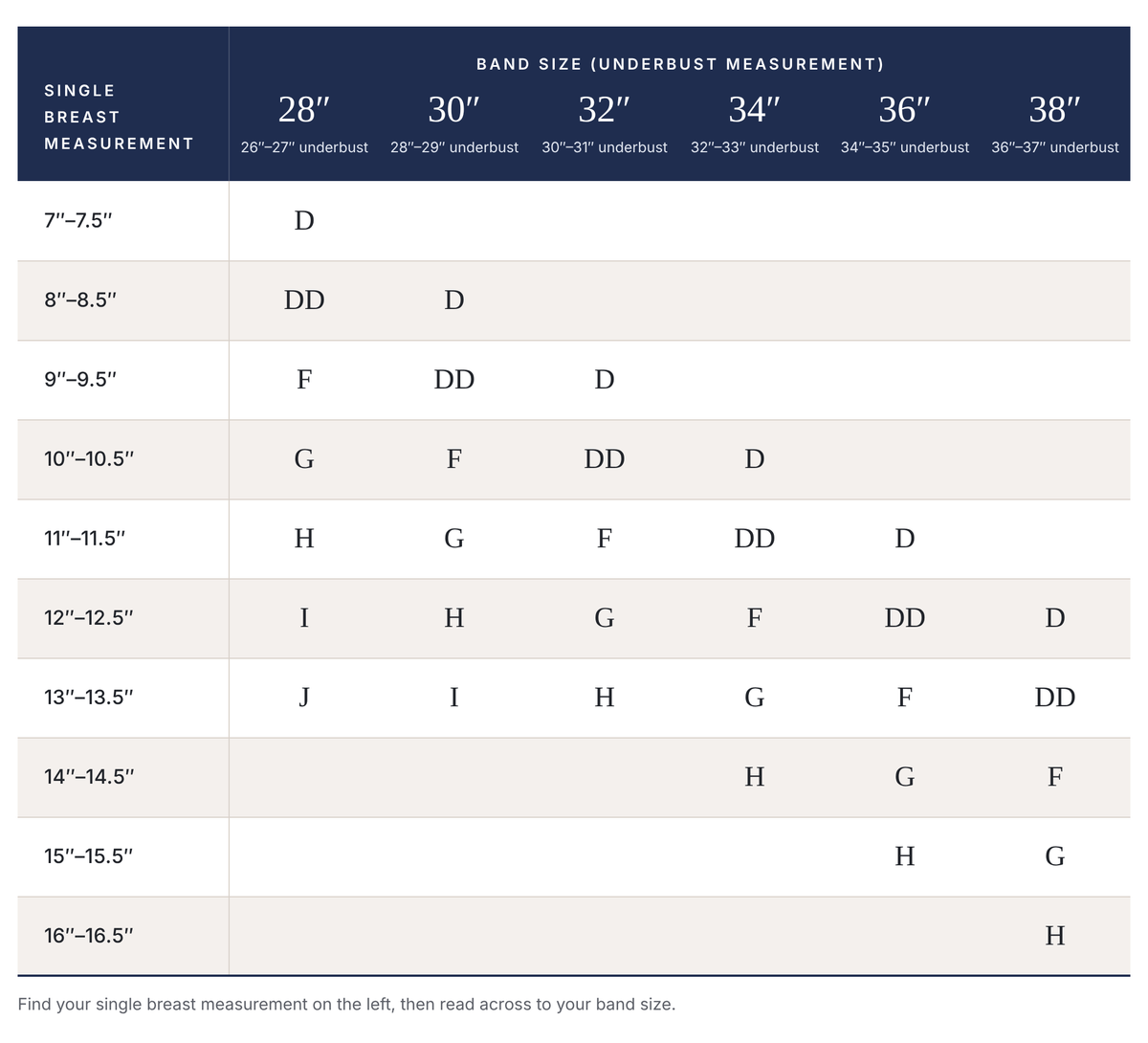
Use the Fig Metrics size chart below: find your band measurement from Step 1 and your one-breast measurement from Step 2.
The cell where they meet is your size.
WHY FIG METRICS?
Most bra sizing works by subtraction: measure around your bust, measure around your ribcage, and the gap between the two becomes your cup size. That shortcut assumes breast tissue that compresses and spreads. But implants don’t, so the gap often points you to the wrong cup.
Fig Metrics measures the breast itself. It builds on the work of plastic surgeon Dr. Edward A. Pechter, who found that measuring the breast directly gives a more accurate cup size compared to subtracting one number from another. We adapted his method for implant anatomy, then refined it in our own fit study of 253 women.
Your band still matters. Cup sizes grow with the band, so the same breast measurement means a different cup on a 32 band than on a 36. Find your band size and your Step 2 measurement on the Fig Metrics size chart above. Where they meet is your size.
Most women with implants have never really been fit. They’ve been accommodated: sized up in the cup and tightened in the band until something holds. But no amount of band tightening fixes a cup that was never built for your shape. Fig Metrics starts from your real measurements, so the fit starts right.
Fit Notes:
- Start on the loosest/outer most hook.
- Your new band should feel snug and secure.
- As it relaxes with wear, move to the tighter hooks to maintain support.
SELECTED CITATIONS
Pechter, E. A. (1998). A new method for determining bra size and predicting postaugmentation breast size. Plastic and Reconstructive Surgery, 102(4), 1259–1265.
Pechter, E. A. (1999). Method for sizing and fitting a woman for a garment (U.S. Patent No. 5,965,809A). U.S. Patent and Trademark Office.
Swanson, E. (2012). A measurement system for evaluation of shape changes and proportions after cosmetic breast surgery. Plastic and Reconstructive Surgery, 129(4), 982–992.